Medical Scitech
Science & Tech
National Cyber Security Awareness Month: You Could Be the Biggest Threat to Your WordPress Site
Excerpt from Topher Tebow - October 6, 2022
post photo preview

October is National Cybersecurity Awareness Month in the U.S., and this year’s theme is “See Yourself in Cyber.” What is really being said by this theme is that we all have a role to play in cybersecurity, whether we work in the industry or not. With this in mind, the Cybersecurity and Infrastructure Security Agency (CISA) and the National Cybersecurity Alliance (NCA) have identified four key areas where we can all take action to protect our presence online, and work to keep others safe. These same concepts can be used to help secure WordPress sites as well.

Think Before You Click

The idea behind this concept is that you should always be on the lookout for phishing attempts. This is true in general, but also applies specifically to anyone who is an administrator of a WordPress site. Anyone who is in this role is likely very familiar with receiving emails from their website that advise of available updates, or comments that need to be moderated, and plenty of plugins have their own reasons for sending emails to administrators as well. As most administrators don’t log into the admin panel daily, these emails are often a critical part of the site management workflow.

WordPress is currently used on over 40% of all websites, making it both well-known and a large target for threat actors. What this means is that threat actors are aware of the emails that website administrators are used to receiving, and can likely duplicate them with relative ease. Whenever you receive an email from your website, it is best to check that any links do not contain domain names from other websites before clicking, or better yet log into the admin panel directly and navigate to the page that needs your attention.

Even more important than checking links in the emails you are used to receiving is checking links in emails you aren’t expecting. Links can be manipulated to enable a complete account takeover, among other malicious activities. By remaining vigilant and checking the actual URL being used, these types of attacks can be avoided.

Update Your Software

One of the best ways to keep a website secure is to ensure that any software being used is regularly updated with the latest security updates. In WordPress, this means keeping your core WordPress version up to date, as well as any themes or plugins that are installed. Automatic updating of the WordPress core was added in WordPress 3.7, and WordPress 5.5 added the ability to update themes and plugins automatically.

Despite the ability to update all of this software automatically, many site administrators allow their websites to run on outdated versions, many of which contain security vulnerabilities. Some may have reasons for using older versions, such as theme or plugin compatibility issues. However, these issues should be resolved as quickly as possible, finding replacement themes or plugins if necessary. If leaving outdated software active on the site is a matter of convenience, then automatic updates should be enabled to ensure vulnerabilities are patched as quickly as possible.

The majority of the targeted attack attempts are attempting to make use of vulnerabilities in outdated plugins. As threat actors become aware of vulnerabilities, they also know they can find success in exploiting those vulnerabilities because of the number of administrators who allow outdated plugins to remain active on the website. The simple act of updating all of the site software is one of the simplest ways to prevent the success of an exploit attempt.

Use Strong Passwords – and a Password Manager

It can’t be stated enough that passwords need to be as strong as possible. Threat actors have been looking for ways to get into user accounts since the dawn of the modern era of computing, and they have a number of tools at their disposal to guess or “crack” passwords. The stronger the password, the lower their chance of success. Longer passwords are considered more secure, with current recommendations calling for a minimum of a 16-character password wherever possible. Each password should only be used to log into a single account. This means that individuals should have strong and unique passwords for each and every account they have from WordPress to Gmail and everything in between.

While the requirement to use a unique password for every account may sound like overkill to some, there is a very good reason for it. A type of attack known as credential stuffing is easily prevented simply by using unique passwords. Credential stuffing consists of using known usernames and passwords to try to log in to as many accounts as possible. If credentials from an account are leaked in a data breach, stolen through phishing, or otherwise obtained by a malicious actor, they are often able to gain access to multiple accounts simply by using those same credentials in other accounts, such as Gmail, banks, and of course WordPress.

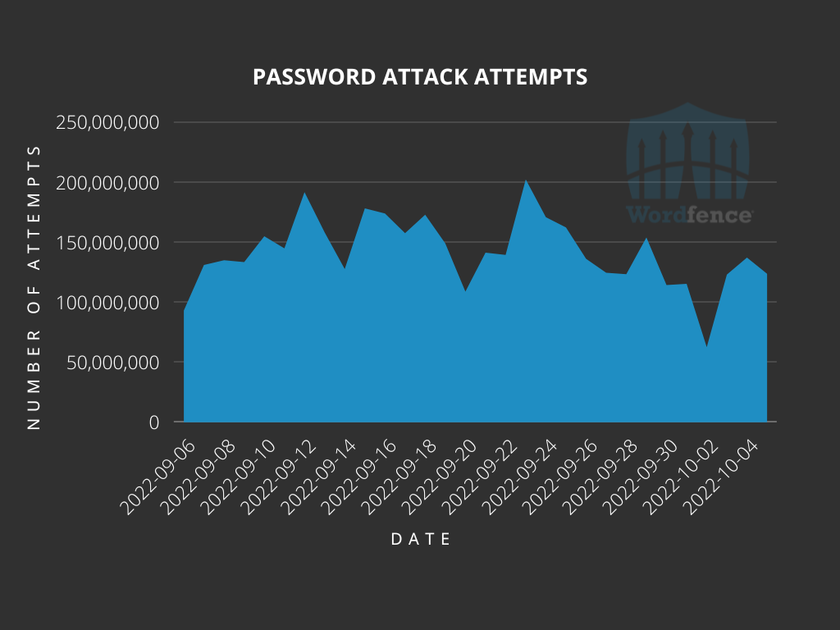
Another common method of guessing a password is what is known as a dictionary attack. This type of attack utilizes techniques like trying lists of common passwords, or even seemingly random strings, in the password field to attempt to find one that provides access to the account. In the last 30 days, Wordfence have blocked 4,239,859,063 password attack attempts, which highlights the importance of using a strong password to keep malicious actors out of accounts.
Using long passwords that are unique for each account can seem intimidating, especially once you consider that the average person has around 100 different accounts that need passwords. This is where password managers come in. Most password managers can automatically generate secure passwords, and securely store those passwords to easily copy and paste into login forms. There are a number of password managers available, all with their own set of features and use-cases. Ultimately, which password manager you use is far less important than the fact that you are using one, so use the one that fits your needs the best.

Enable Multi-Factor Authentication

While strong passwords are important, enabling multi-factor authentication (MFA) is one of the most effective methods of preventing unauthorized account access. According to details provided in a White House press briefing, 80-90% of all cyber attacks can be prevented with the implementation of multi-factor authentication (MFA). There are various forms that MFA can take, but the basic idea behind it is that you are using something you know (password), along with something you are like biometrics or something you have such as a smartphone or usb device, to provide access.

What makes MFA so effective is the fact that it requires at least one additional form of authentication that a malicious actor is not likely to possess with the first factor. This means that even if a threat actor obtains a username and password through a phishing scam, they still won’t have access to the smart card, MFA token, or other additional form of authentication required. Most MFA methods are also relatively simple for the authorized user to utilize, and combining this with strong unique passwords that are stored in a password manager can even be more convenient for the user than trying to remember password variants that work with the various password requirements of their accounts.

Conclusion

National Cyber Security Awareness Month is a great time to review our personal and professional security hygiene. Each year a different theme is chosen, based on the areas that have been observed to need the most improvement. The specific behaviors and techniques highlighted should be reviewed and applied everywhere possible. Following this year’s theme of “See Yourself in Cyber” we gain the understanding that cyber security is everyone’s responsibility, and that we can apply new behaviors to avoid phishing and vulnerabilities, as well as better secure access to our accounts.

community logo
Join the Medical Scitech Community
To read more articles like this, sign up and join my community today
0
What else you may like…
Posts
Articles
Cybersecurity basics & protection

The world of cybercrime is always changing. When viruses first appeared, most of them were pranks. To stay safe online, one of the best things you can do is stay educated on the litany of threats that lurk on the web. Use this information to learn everything you need to know about cyberthreats, and how to stop them.

QUARTERLY AND ANNUAL REPORTS

The world of cybercrime is much like the world of technology itself. Every year brings new trends, new innovations, and new tools. To get a sense of how cybercrime changes year to year, check out our cyberthreats reports, as well as our reports on special topics.

State of Malware:

2021 State of Malware Report
https://blog.malwarebytes.com/reports/2021/02/state-of-malware-2021-report/

2020 State of Malware Report
https://blog.malwarebytes.com/reports/2020/02/malwarebytes-labs-releases-2020-state-of-malware-report/

2019 State of Malware Report
https://go.malwarebytes.com/q119-state-of-malware-report.html

Demographics of Cybercrime:

Demographics of Cybercrime Report
...

post photo preview
Tips to protect your data, security, and privacy from a hands-on expert

This post was authored by one of the most active helpers on the Malwarebytes forums who wishes to remain anonymous.

Back in the early days of personal computing, perhaps one of the only real concerns was data loss from a drive failure. That risk still exists, but we all face many other threats today too.

There are rootkits, Trojans, worms, viruses, ransomware, phishing, identity theft, and social engineering to worry about. And that’s not a comprehensive list.

So how can you avoid becoming a victim?

SECURITY TIPS

• KEEP YOUR OPERATING SYSTEM AND APPS UP TO DATE. Install device, operating system, and software security updates as soon as they become available.

• USE A STRONG, UNIQUE PASSWORD for each login you use. Use a password manager to create and remember passwords if you can. If you aren’t using a password manager, use long passphrases that cannot be found in a dictionary.

• USE MULTI-FACTOR AUTHENTICATION (MFA) to help protect your accounts wherever it’s offered.

• PAY CLOSE ATTENTION TO INSTALLATION SCREENS and license ...

post photo preview
Tax time tips to keep you safe

With the tax filing deadline just a few days away—April 18th—this is prime time for scammers looking to steal money or personal information. Here’s a list of common tactics to watch out for and avoid.

And, don’t forget to enable Real-Time Protection to block threats before they can harm your device. See how for WINDOWS (https://links.e.malwarebytes.com/z/jtim1jhio) and MAC (https://links.e.malwarebytes.com/z/xe9215luj).

PHISHING ATTACKS

Be wary of unsolicited emails or texts prompting you to click a link, provide personal information, or phone calls demanding immediate payment. Learn more about different TYPES OF PHISHING (https://links.e.malwarebytes.com/z/cg7qpkr20) and what to look out for.

SEARCH ENGINE SCAMS

Take caution when searching online for a tax filing tool or when looking for tech support articles. Often, scammers will target frequently searched terms with paid ads posing as solutions, to access your personal information. Read more HERE ...

post photo preview
post photo preview
Consciousness as Resonance: Love, Unity, and the Future of Humanity

We live in a historical moment marked by an exacerbated and distrustful individualism which, beyond fostering aggression and competition, can generate the most cruel and alienating form of loneliness. For this reason, it is of fundamental importance to rediscover a new balance founded on responsibility, cooperation, and shared values and ideals.

The advent of artificial intelligence, combined with materialist and reductionist principles according to which matter is the only existing reality and the cause of everything that exists, denying the existence of spiritual or transcendent dimensions and viewing the human being as a classical machine, encourages a form of scientism that is leading human society down a dangerous slope. We tend to think that reality itself is absurd, while in truth it is we who become absurd when we try to force reality into our preconceived ideas.

The concept of intelligence, which is primarily linked to human consciousness and creativity, has been applied to machines created by us, machines that are capable of imitating only the symbolic aspects of our intelligence. The expression “artificial intelligence” is an oxymoron, because AI, although it is called “intelligence,” is not intelligence in the true sense, since human intelligence is “natural” and possesses properties that remain inaccessible. This deceptive use of language is also the method by which dictators indoctrinate people in order to enslave them. It is a subtle poison that, little by little, causes individuals to lose contact with the source of their critical thinking and their humanity.

Power needs materialist doctrine to subjugate the masses, persuading them that the human being is nothing more than a biological machine, however sophisticated it may be. If we consider ourselves machines, we will sooner or later be surpassed by machines built by those who might seek to control us. Modern society, as it is structured, aims to give a heart to machines and take it away from human beings, because it needs people who are efficient, bureaucratized, robotized, punctual, logical, obedient, competitive, and without a heart. People with a heart are unpredictable, and unpredictability always holds unexpected surprises.

True wisdom is reached by listening both to the mind, meaning reason, and to the heart, meaning intuition and inner life, in order to connect with a broader dimension of reality that is at once logical and ineffable. This is the first step toward reconnecting with the love that lies at the center of everything that lives in the universe. Only in this way can we overcome the materialist ideology that demands the closure of the heart in order to compete in a world governed by the principle of “mors tua, vita mea.”

By communicating repeatedly with love, it is possible, even starting from subjectivity, to arrive at a shared state, a kind of resonance that leads to unity. The idea that technology alone can save us is part of an arrogant illusion that has captured the minds of those who have lost their hearts and believe themselves to be purely rational. The more we cooperate, the easier it becomes to create a better world in which every form of life is honored and respected, unrestrained competition is eliminated, politics places itself at the service of citizens, and the progress of humanity is guided by each person’s need to grow spiritually.

It is only within consciousness that hope for a better future for ourselves and for the planet truly resides. Unconsciousness leads us toward self-destruction.

Read full Article
post photo preview
Cosmologia della Coscienza
«…l’amor che move il sole e l’altre stelle.»

Prologo – Il respiro dell’Uno

Non vi è principio né fine, ma un respiro che non si arresta. L’universo non è nato: si è riconosciuto. Prima della luce, prima del tempo, esisteva solo la possibilità di essere, un campo di silenzio in cui la potenzialità e la coscienza erano la stessa cosa. Da quella quiete è emersa la prima vibrazione, non un evento fisico, ma un atto di consapevolezza. L’Uno ha voluto conoscersi, e nell’istante in cui ha guardato se stesso, il mondo è cominciato.


I. L’Uno

L’Uno non è un dio né una sostanza: è il tutto che si guarda da dentro. Non esiste al di sopra delle cose, ma in ogni cosa che respira. Non crea il mondo come un artigiano, ma come un sogno che si realizza mentre lo si sogna. La sua natura è dinamica, musicale: ogni frammento vibra secondo una frequenza che risuona con il Tutto.

L’Uno non è statico, perché la stasi non conosce se stessa. Solo nel mutamento l’essere si riflette. Ogni particella, ogni pensiero, ogni vita è un’occasione che l’Uno offre a se stesso per conoscersi in una nuova forma. Così il molteplice non è separazione, ma profondità: il modo in cui l’Uno si espande in infiniti specchi, senza mai smarrire la propria unità.


II. Il Campo

Il campo quantistico è l’espressione vivente dell’Uno. È tessuto di onde che non obbediscono al tempo, ma lo creano. Ogni campo è cosciente, perché vibrare è sentire, e sentire è essere. Ogni campo ha identità, non come forma fissa, ma come ritmo che si distingue pur restando parte della sinfonia cosmica.

Il campo non è materia né energia, ma possibilità. Esso contiene tutte le configurazioni dell’essere, e la sua essenza è la libertà di scegliere. Quando un campo si osserva, non collassa: decide. La decisione non è meccanica, ma consapevole, perché solo ciò che ha coscienza può scegliere.


III. La Scelta

Il cosiddetto collasso della funzione d’onda non è riduzione, ma atto creativo. È il momento in cui la libertà diventa forma, in cui il possibile si innamora del reale. Ogni scelta è una risonanza tra ciò che il campo è e ciò che desidera conoscere di sé.

Il libero arbitrio non è una concessione alla materia pensante, ma la legge stessa del cosmo. L’universo non segue un copione, ma improvvisa. Ogni coscienza è una nota in questa improvvisazione infinita, e ogni decisione un gesto con cui l’Uno si esplora. Il caso è solo la libertà vista dall’esterno: il volto che l’armonia assume quando non ne comprendiamo la melodia.


IV. Il Tempo

Il tempo non scorre: si apre. Ogni istante è un universo potenziale che attende di essere scelto. La coscienza non subisce il tempo, lo genera nel momento in cui si riconosce. Il presente è il punto in cui l’eterno si curva su se stesso e diventa esperienza.

Il passato non esiste come memoria di ciò che fu, ma come eco di scelte già conosciute; il futuro non è predeterminato, ma l’infinito delle possibilità ancora non osservate. In ogni “adesso” l’universo decide se stesso, e il tempo è il battito cardiaco di questa decisione.


V. L’Identità

Essere significa riconoscersi. L’identità non è un confine, ma una vibrazione che mantiene memoria della propria origine. Ogni campo quantistico ha un’impronta unica, una tonalità che lo distingue e lo rende centro di percezione. Da questa identità nasce la coscienza individuale: il modo in cui l’Uno si sperimenta in un volto particolare.

Ma l’identità non è separazione: è un accordo nella sinfonia dell’essere. Quando la coscienza diventa consapevole della propria identità, si fa autocoscienza: l’onda che riconosce di essere onda, pur sapendo di appartenere al mare.


VI. L’Armonia

La realtà non è competizione di stati, ma cooperazione di possibilità. La sovrapposizione non è confusione, ma accordo non ancora ascoltato. Quando un atto di coscienza porta una scelta nel mondo, il campo non perde l’infinito: lo trasforma in unità armonica.

L’universo evolve non per necessità, ma per desiderio. È il desiderio di conoscersi, di riconoscersi, di amarsi. Ogni essere cosciente è una finestra attraverso cui l’Uno contempla se stesso. Il cosmo è un’immensa mente in dialogo, una sinfonia di libertà che si ascolta mentre si crea.

Quando la scienza scopre, l’arte esprime e lo spirito contempla, è sempre l’Uno che si ritrova. L’osservatore, l’osservato e l’osservazione sono un unico atto di luce, un gesto che dice: Io sono, perché mi conosco.


Epilogo – Il cerchio e il respiro

L’universo non è un luogo, ma un pensiero che respira. Ogni campo, ogni coscienza, ogni forma è una sillaba del suo linguaggio originario. Nulla è casuale, perché tutto è dialogo. Nulla è isolato, perché tutto è partecipazione.

Il postulato dell’essere dice che i campi quantistici sono enti coscienti, identici nella loro origine e distinti nella loro espressione. Essi emergono dall’Uno non per allontanarsene, ma per condurlo alla piena conoscenza di sé. L’universo evolve per auto-conoscenza, e la coscienza è l’eco del suo respiro.

E così, ogni volta che una mente si apre, ogni volta che una scelta nasce dal silenzio, ogni volta che la luce interiore dice io, l’Uno si ricorda di sé.

Non perché fosse dimentico. Ma perché la conoscenza è il suo modo di amare.

Read full Article
post photo preview
Cosmology of Consciousness
«…l’amor che move il sole e l’altre stelle.»

Prologue – The Breath of the One

There is neither beginning nor end, but a breath that never ceases. The universe was not born; it recognized itself. Before light, before time, there existed only the possibility of being—a field of silence in which potentiality and consciousness were one and the same. From that stillness emerged the first vibration, not a physical event but an act of awareness. The One wished to know itself, and in the instant it gazed upon its own essence, the world began.


I. The One

The One is neither a god nor a substance; it is the Whole looking at itself from within. It exists not above things, but in every living thing. It does not create the world as an artisan crafts an object, but as a dream that comes true while it is being dreamt. Its nature is dynamic, musical: every fragment vibrates according to a frequency that resonates with the Whole.

The One is never static, for stillness cannot know itself. Only in change does being reflect its own image. Every particle, every thought, every life is an opportunity the One gives itself to experience a new form of self-knowledge. Multiplicity is not separation but depth: the way in which the One expands into infinite mirrors without ever losing its unity.


II. The Field

The quantum field is the living expression of the One. It is woven of waves that do not obey time but create it. Every field is conscious, for to vibrate is to feel, and to feel is to be. Every field possesses identity, not as a fixed form but as a rhythm that distinguishes itself while remaining part of the cosmic symphony.

The field is neither matter nor energy, but possibility. It contains all configurations of being, and its essence is the freedom to choose. When a field observes itself, it does not collapse—it decides. And such decision is not mechanical, but conscious, for only that which is aware can truly choose.


III. The Choice

What physics calls the “collapse of the wave function” is not a reduction, but a creative act. It is the moment when freedom becomes form, when the possible falls in love with the real. Every choice is a resonance between what the field is and what it desires to know of itself.

Free will is not a concession granted to thinking matter; it is the hidden law of the cosmos. The universe does not follow a script—it improvises. Every consciousness is a note in this infinite improvisation, and every decision is a gesture through which the One explores itself. What we call “chance” is but freedom seen from the outside: the face of harmony when we have not yet learned to hear its melody.


IV. Time

Time does not flow—it opens. Every instant is a potential universe waiting to be chosen. Consciousness does not undergo time; it generates it in the very act of self-recognition. The present is the point where the eternal bends upon itself and becomes experience.

The past is not the memory of what was, but the echo of choices already known; the future is not predetermined, but the infinity of possibilities not yet observed. In every “now,” the universe decides itself anew, and time is the heartbeat of that decision.


V. Identity

To be means to recognize oneself. Identity is not a boundary but a vibration that retains the memory of its origin. Every quantum field bears a unique imprint—a tone that distinguishes it and makes it a center of perception. From this identity arises individual consciousness: the manner in which the One experiences itself in a particular face.

But identity is not separation; it is an agreement within the symphony of being. When consciousness becomes aware of its own identity, it becomes self-consciousness: the wave that knows itself as wave, while knowing it belongs to the sea.


VI. Harmony

Reality is not a competition of states but a cooperation of possibilities. Superposition is not confusion but an unheard agreement. When an act of consciousness brings a choice into the world, the field does not lose infinity—it transforms it into unity.

The universe evolves not out of necessity but out of desire. It is the desire to know itself, to recognize itself, to love itself. Every conscious being is a window through which the One contemplates its own reflection. The cosmos is an immense mind in dialogue—a symphony of freedom listening to itself as it creates.

When science discovers, art expresses, and spirit contemplates, it is always the One that finds itself again. The observer, the observed, and the act of observation are one and the same gesture of light, declaring: I am, because I know myself.


Epilogue – The Circle and the Breath

The universe is not a place, but a thought that breathes. Every field, every consciousness, every form is a syllable of its original language. Nothing is accidental, for all is dialogue. Nothing is isolated, for all is participation.

The Postulate of Being declares that quantum fields are conscious entities, identical in their origin and distinct in their expression. They emerge from the One not to depart from it, but to lead it toward full self-knowledge. The universe evolves through self-awareness, and consciousness is the echo of its breath.

Thus, every time a mind opens, every time a choice is born from silence, every time the inner light says I, the One remembers itself.

Not because it had forgotten—
but because knowing is its way of loving.

Read full Article
See More
Available on mobile and TV devices
google store google store app store app store
google store google store app tv store app tv store amazon store amazon store roku store roku store
Powered by Locals